
@realty sold $533,969,817 worth of property across Australia and New Zealand in February a strong result and a great reflection of continued activity across our network.
Key findings:
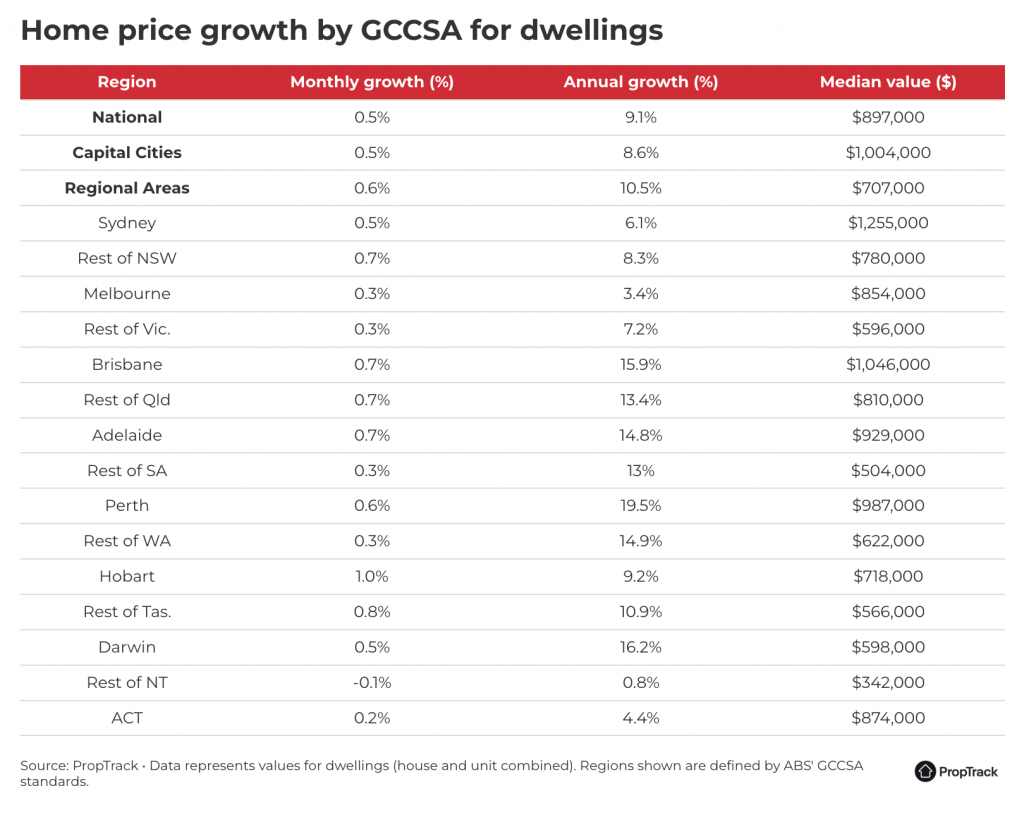
- National home prices increased 0.5% in February, taking the national median home value to $897,000. Prices are now 9.1% higher than a year ago, adding around $90,000 to the value of the median home.
- Capital city prices rose 0.5% in February, lifting the median home value in the capitals over $1,000,000 for the first time.
- Hobart was the strongest performing capital in February (+1.0%), followed by Brisbane (+0.7%) and Adelaide (+0.7%).
- Perth was the fastest growing capital in the past (+19.5%), followed by Darwin (+16.2%), Brisbane (+15.9%) and Adelaide (+14.8%).
- Across the capital cities, annual growth for houses and units remains similar. However, momentum is shifting, with units outpacing houses over the past quarter. This suggests demand may be shifting toward more affordable stock as borrowing capacity remains constrained.
- Regional prices climbed 0.6% in February and were up 10.5% year-on-year. Regional growth has outpaced the capitals over the past year (10.5% vs 8.6%) and five years (59% vs 41%), supported by relative affordability and lifestyle appeal.
National home price growth gathered pace in February, in line with the usual seasonal rebound in housing market activity following the holiday period. Home values increased by 0.5% over the month, pushing the national median price to $897,000. Over the past year, prices have climbed 9.1%, adding approximately $90,000 to the value of the typical Australian home.
Capital city markets also recorded a 0.5% rise in February, taking the median dwelling value across the capitals beyond $1 million for the first time.
Hobart led the monthly gains among the capitals, rising 1.0%, followed by Brisbane and Adelaide, both up 0.7%. Over the past year, Perth has been the standout performer, surging 19.5%, ahead of Darwin (16.2%), Brisbane (15.9%) and Adelaide (14.8%).
While annual growth rates for houses and units remain broadly aligned across the capitals, recent trends suggest a shift in momentum. Over the past quarter, unit values have outperformed houses, indicating buyers may be gravitating toward more affordable property types as borrowing capacity remains tight.
Regional markets also continued to strengthen, with prices rising 0.6% in February and 10.5% over the past 12 months. Over the past year and five years, regional growth has exceeded that of the capital cities (10.5% versus 8.6% annually, and 59% versus 41% over five years), supported by relative affordability and lifestyle appeal.
Values increased across every capital city in February, with national growth now tracking at its fastest annual pace since June 2022. Hobart’s market has notably reaccelerated, recording the strongest monthly gain while total listings remain around 30% lower than a year ago. In most capitals — with the exception of Hobart — unit prices are outperforming houses on both a quarterly and annual basis, reflecting buyers’ preference for more attainable options.
The strongest market conditions remain concentrated in cities where demand continues to outstrip supply, particularly Perth, Darwin, Brisbane and Adelaide. Although the Reserve Bank’s February rate rise is expected to place some pressure on borrowing capacity, several factors are underpinning demand, including a tight labour market, strong population growth, heightened investor activity and the expanded Home Guarantee Scheme. At the same time, limited new housing supply is helping to support prices.
Looking ahead, further price growth appears likely. However, conditions are expected to become more moderate and uneven, as affordability constraints and the prospect of additional rate increases temper momentum throughout 2026.